Author: Canada News

  • Top 10 Law Colleges in Canada

    Top 10 Law Colleges in Canada

    Several major law schools in Canada provide great legal education and generate highly talented legal practitioners. These schools are well-known for their demanding academic programmes, prominent faculty, and dedication to legal research and practise excellence. Students interested in a career in law can benefit from these top law schools’ extensive curriculum, experiential learning opportunities, and different areas of specialisation.


    Osgoode Hall Law School – York University (Toronto, Ontario):
    Osgoode Hall Law School is one of Canada’s oldest and most prestigious law schools. It offers a wide range of programs, including J.D., LL.M., and Ph.D. programs. Osgoode Hall is known for its strong faculty, diverse curriculum, and extensive experiential learning opportunities.

    Faculty of Law – University of Toronto (Toronto, Ontario):
    The Faculty of Law at the University of Toronto is consistently ranked among the top law schools in Canada and worldwide. It offers a rigorous J.D. program and a vibrant research community. The faculty is renowned for its interdisciplinary approach to legal education and its focus on public interest law.

    Faculty of Law – McGill University (Montreal, Quebec):
    The Faculty of Law at McGill University is one of the oldest law schools in Canada and is recognized internationally for its excellence in legal education and research. It offers a bilingual J.D. program and an LL.M. program with various specializations. McGill Law School has a strong emphasis on legal theory and comparative law.

    Peter A. Allard School of Law – University of British Columbia (Vancouver, British Columbia):
    The Allard School of Law at the University of British Columbia is known for its innovative programs and commitment to social justice. It offers a comprehensive J.D. program, LL.M. degrees, and a Ph.D. program. The school places a strong emphasis on experiential learning and offers clinics, internships, and global exchange opportunities.

    Faculty of Law – University of Alberta (Edmonton, Alberta):
    The Faculty of Law at the University of Alberta is a leading law school known for its strong faculty and collaborative learning environment. It offers a J.D. program, LL.M. degrees, and a Ph.D. program. The school focuses on interdisciplinary legal education and offers specialized programs in areas such as energy law and Indigenous law.

    Faculty of Law – University of Ottawa (Ottawa, Ontario):
    The Faculty of Law at the University of Ottawa is recognized for its bilingual programs and its location in the capital city of Canada. It offers a J.D. program, LL.M. degrees, and a Ph.D. program. The school is known for its expertise in areas such as constitutional law, human rights, and technology law.

    Schulich School of Law – Dalhousie University (Halifax, Nova Scotia):
    The Schulich School of Law at Dalhousie University has a rich history and offers a strong legal education. It provides a J.D. program, LL.M. degrees, and a Ph.D. program. The school is known for its focus on social justice, maritime law, and health law.

    Faculty of Law – University of Calgary (Calgary, Alberta):
    The Faculty of Law at the University of Calgary offers a dynamic legal education with a focus on experiential learning and interdisciplinary research. It provides a J.D. program, LL.M. degrees, and a Ph.D. program. The school is renowned for its strong connections to the legal profession and its innovative curriculum.

    Faculty of Law – Queen’s University (Kingston, Ontario):
    The Faculty of Law at Queen’s University offers a vibrant and rigorous legal education. It offers a J.D. program, LL.M. degrees, and a Ph.D. program. The school is known for its small class sizes, supportive community, and strong alumni network.

    Bora Laskin Faculty of Law – Lakehead University (Thunder Bay, Ontario):
    It’s located in Thunder Bay, Ontario, is a unique institution that offers a specialized legal education. The faculty is committed to providing students with a comprehensive understanding of the law and legal systems, with a particular focus on addressing the needs of Northern Ontario and Indigenous communities.


    These top law colleges in Canada offer exceptional programs, faculty expertise, and opportunities for students to engage in experiential learning, research, and community involvement. Aspiring lawyers can find their ideal educational experience within these renowned institutions, positioning themselves for successful legal careers in Canada and beyond.


  • Around 70,000 Summer Jobs Posted by The Government of Canada

    Around 70,000 Summer Jobs Posted by The Government of Canada

    The Government of Canada has listed around 70k jobs in its portal.

    Today, the Canada Summer Jobs (CSJ) 2020 officially taken a step, with the goal of providing thousands of summer jobs to Canadians aged 15 to 31. If you were looking for a way to earn some cash this summer, look no further


    The Canadian government wants to help you find a job and you can use the job bank portal to see the newly listed jobs and can also find the special COVID 19 essential jobs.


    Login at this job search portal and start finding a job for you now.

  • Ontario unveils reopening plans are out : 3 Phrases

    Ontario unveils reopening plans are out : 3 Phrases

    After Saskatchewan, Ontario opening plan is here.


    “Together, Ontario will emerge from this crisis – with a clear path to economic recovery that keeps people safe and healthy.”


    PHASE ONE: PROTECT AND SUPPORT

    The first of the three phases is already underway. This phase focuses on protecting the health and well-being of individuals and families, as well as supporting frontline health-care workers. It also focuses on emergency orders put in place that shutdown non-essential workplaces, outdoor amenities at parks, recreational areas, and public places, as well as put restrictions on social gatherings.

    Ontario’s Action Plan: Responding to COVID-19 is part of this phase. The $17-billion plan was released on March 25.

    PHASE TWO: RESTART

    This phase is broken down into three stages that provide a “careful approach” to loosening emergency measures and therefore reopening Ontario’s economy, the framework states.

    During this phase, the government says public health and workplace safety “will remain the top priority,” while balancing the needs of people and businesses.

    Each of the following three stages will be monitored by health officials for two to four weeks.

    Stage one: Open select workplaces, allow some small gatherings

    •  Businesses that can “immediately meet or modify operations” to meet public health guidance, for example, those that can conduct curbside pickup or delivery
    •  Opening some outdoor spaces, such as parks, and allowing for “a greater number of individuals” to attend some events, such as funerals
    •  Hospitals begin to offer some non-urgent surgeries and other health-care services

    Stage two: Open more workplaces and outdoor spaces, allow some larger gatherings

    •  May include some service industries and additional office and retail workplaces

    Stage three: Further relax restrictions on public gathers, opening all workplaces

    •  Large public gatherings, such as concerts and sporting events will continue to be restricted for “the foreseeable future”

    After each two-to-four-week period, health officials may advise to “reapply or tighten certain public health measures,” “maintain status quo,” or “progress to the next stage.”

    “This ongoing gradual assessment of public health measures will continue until the post-pandemic period when a vaccine or treatment for COVID-19 is available.”

    PHASE THREE: RECOVER

    This phase includes Ontario transitioning to its “new normal” and will focus on creating jobs across the province while ensuring that workplaces are following strict health and safety guidelines.

    “Remote work arrangement should continue where feasible,” the province states.


  • Gunman dressed as policeman kills 16 in Canada’s worst mass shooting

    Gunman dressed as policeman kills 16 in Canada’s worst mass shooting

    A gunman who dressed as a policeman killed at least 16 people, including a female police officer, in the province of Nova Scotia, Canada. The attacker was killed by the police. This is the country’s worst mass shooting as the death toll exceeded that of a Montreal massacre in 1989 when a gunman killed several women.


    The Royal Canadian Mounted Police said the gunman, 51-year-old Gabriel Wortman, who worked as a denturist, appeared at one stage to have been wearing part of a police uniform. He had also painstakingly disguised his car to look like a police cruiser.

    Wortman shot people in several locations in Nova Scotia, the RCMP told a briefing. RCMP Commissioner Brenda Lucki told the Canadian Broadcasting Corp the police knew of at least 16 victims, besides the shooter. She added there was no indication at this time that the killings were terrorism-related.

    Nova Scotia Premier Stephen McNeil decried what he called a senseless act of violence.

    Canadian Prime Minister Justin Trudeau said his government would help Nova Scotians “as they heal from this tragedy.”


  • Canadian Family Drove for Two Days with Dad’s dead body to avoid U.S. healthcare

    Canadian Family Drove for Two Days with Dad’s dead body to avoid U.S. healthcare

    Police say they’re investigating after a family attempted to cross into Canada with the corpse of a parent in the back of a van.

    Sûreté du Québec told the Canadian Press, the van’s passengers were a man in his 60s and his two parents, one alive and one deceased. Police say that the call was initially for an unconscious person in the back of the van but when paramedics attended the scene they found that the man had been dead for at least two days. Police say they stopped the van at around 2:30 AM on Sunday at Quebec’s Hemmingford crossing and are investigating.

    The man and his two elderly parents were reportedly driving back to Canada after a trip to Florida. La Presse reports that during the long drive home the father suffered a heart attack and died en route to Canada.

    The mother and son reportedly didn’t want to use the American healthcare system and, further to that, once he was dead, didn’t want to deal with repatriating the body from America to Canada (something that can also be pricey). So, with the cost of medical treatment and flying his body back to Canada in their mind, the two continued their drive north with a dead father in the back of the van.


    Making the choice to drive for miles upon miles with the slowly decomposing body of a loved one is incredibly morbid stuff, but one can see the logic in it. For many Canadians a surprise medical expense in the States can break them financially.


    In a famous case from 2014, a Saskatchewan mother had an early, emergency delivery of her daughter while on vacation in Hawaii. The mother had travellers insurance but they, being an insurance company and all, decided not to pay her claim because of a “pre-existing condition” that had nothing to do with the birth. The woman was charged $950,000 in medical bills and their daughter became known as the “Million Dollar Baby.”

    This isn’t to say that the Canadian health care system is perfect—it could still be improved significantly, obviously—but, at the very least, it’s telling what country the two wanted to be in to deal with the death of a loved one.


    Via Vice

  • 5 things to know about the Ontario budget

    5 things to know about the Ontario budget

    TORONTO — Ontario’s Progressive Conservative government tabled its first budget Thursday. Here are five things to know about the $163 billion spending package.

    PATH TO BALANCE: The Tories plan to take five years to balance the books, which means the deficit will not be eliminated before the next election. They say they inherited a $15 billion deficit from the previous Liberal government that has since been cut to $11.7 billion. The Tories plan to reduce the deficit by $1.4 billion in 2019-2020 to $10.3 billion, and further decrease it by $3.5 billion in 2020-2021 to $6.8 billion — the largest scheduled reduction during their term. They plan to achieve balance in 2023-2024.

    CHILD-CARE TAX CREDIT: The government is creating a new tax credit to help low- and middle-income families pay for child care. The Ontario Childcare Access and Relief from Expenses credit, which applies on a sliding scale to families with incomes of up to $150,000, will provide a rebate of up to 75 per cent of care, including in child-care centres, homes and camps. Families could receive up to $6,000 per child under seven, and up to $3,750 per child between seven and 16. It would provide a rebate of up to $8,250 for a child with a severe disability. The credit would cost about $390 million annually.

    POST-SECONDARY CUTS: The Tories plan to cut post-secondary spending by roughly $400 million — from $12.1 billion in 2018-2019 to $11.7 billion in 2021-22. The government says it plans to gradually link more of college and university funding to student performance. It will tie 60 per cent of a school’s funding by 2024-2025 to yet-to-be finalized metrics that will include student skills and job outcomes. The budget also contains a previously announced 10 per cent tuition cut that takes effect this fall.

    HEALTH-CARE SPENDING: The province will hike hospital spending by $384 million, which represents a two per cent increase in 2019-2020. The Ontario Hospitals Association had requested a 3.4 per cent increase to help meet increasing needs. The province will also spend an additional $267 million in home care and community care. The Tories further promise to create 15,000 new long-term care beds and upgrade an additional 15,000 older long-term care beds. The budget also contains a program to provide free dental care for low-income seniors. It will apply to those with annual incomes less than $19,300 or couples who earn less than $32,300.

    CHANGES TO ALCOHOL REGULATIONS: The government plans to change a series of laws governing alcohol sales. The changes would permit municipalities to pass laws that allow drinking in some public areas like parks. They would also extend the hours a licensed establishment can serve booze, starting at 9 a.m., seven days a week. The province will also change rules to allow bars to advertise “happy hour” promotions. The government says it will also look at ways to lower beer costs at Royal Canadian Legions by this fall.

    Shawn Jeffords , The Canadian Press

  • 3 of World’s 10 Best Livable Cities (2018) are of Canada, Here is the list

    3 of World’s 10 Best Livable Cities (2018) are of Canada, Here is the list

    Three of Canada’s cities are maintaining their spot in the list of world’s top 10 livable cities.


    The factors considered are as follows:

    1. Stability: This category examines the prevalence of crime, threat of terror/ military conflict or civil unrest.
    2. Healthcare: This category focuses on the availability/quality of private and public healthcare, over-the-counter drugs and other general healthcare indicators.
    3. Culture and Environment: This category measures various indicators that range from temperature rating, climate, level of corruption, social or religious restrictions, food/drink, and other social indicators.
    4. Education: The category looks at the availability/quality of private and public education.
    5. Infrastructure: This category is an assessment of the quality of roads, public transportation, availability of housing, and other indicators.

    The Canadian cities which are in the list are  Calgary,Toronto,Vancouver.

    These three cities are the only North American cities in the top 10 of the Economist Intelligence Unit (EIU)’s 2018 Global Liveability Index.

    In comparison to the EIU’s 2017 survey results, Calgary replaced Toronto in 4th place, Vancouver dropped three places to 6th and Toronto dropped three places to 7th.


    Here is the list of 10 most liveable cities 2018:

    1. Vienna, Austria
    2. Melbourne, Australia
    3. Osaka, Japan
    4. Calgary, Canada
    5. Sydney, Australia
    6. Vancouver, Canada
    7. (tie) Toronto, Canada
    7. (tie) Tokyo, Japan
    9. Copenhagen, Denmark
    10. Adelaide, Australia
  • Almost 80-year-old ballet dancer finds way to live out her dream

    Almost 80-year-old ballet dancer finds way to live out her dream


    Ballet dance movement always fascinate Fay Richardson At the age of 79 she is living out her childhood dream and being the oldest dancer at the Youth Ballet and Contemporary Dance of Saskatchewan, a Regina-based dance school.

    She admits it that she isn’t as speedy compares to other dancers.She began dancing as an adult at the age of 45, enjoyed the motions of ballet and yes thoughts about quitting come but each time fellow students encouraged her ”

    Fay Richardson
    The encouragement from her fellow dancers fills Richardson with emotion.”It’s also special in the way that the others don’t say give up, or get out and let us show off at a better level. They bring me to their level, somehow.”

  • Mother makes kids walk for 7 km, holding sign saying they were rude to bus driver

    Mother makes kids walk for 7 km, holding sign saying they were rude to bus driver

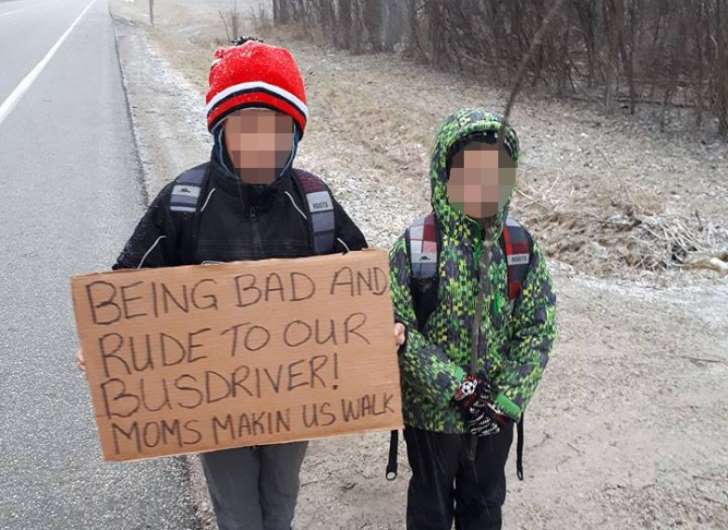
    It isn’t the seven-kilometre walk, or even the cardboard sign that read, in all capital letters: “Being bad and rude to our bus driver! Moms makin us walk.”

    For the local Children’s Aid Society, the issue is a Harrow, Ont., mom’s decision to post photos of her punishing her two elementary-aged sons to social media.

    In a Facebook post published Tuesday, the mother wrote she took action after getting a call from her sons’ school about their poor behaviour.

    “That drew the line for me! This morning we did a 7 km walk to show them what everyday will be like for them when they get kicked off the bus!” she wrote.

    “2 hours later they made it!” To protect the identities of the children, CBC News is not naming the mother.

    a close up of a sign: The mother posted photos of the boys walking on Facebook Tuesday. The post has since gone viral with 30,000 shares and more than 24,000 reactions. Dozen commented in support of the mother's actions.© Facebook The mother posted photos of the boys walking on Facebook Tuesday. The post has since gone viral with 30,000 shares and more than 24,000 reactions. Dozen commented in support of the mother’s actions.

    The post had been shared more than 38,000 times by 5:30 p.m. ET on Thursday. It received more than 28,000 “likes” and other reactions and dozens of comments, most of which seem to celebrate the actions of a “real parent.”

    “You re fricken rockin the mom hat girl good job,” wrote one commenter.

    “Awesom job mom!!” added another. “This is how you raise children.”

    a screenshot of a cell phone: Dozens of people took to Facebook to comment in support of the mom's method of punishment.© Facebook Dozens of people took to Facebook to comment in support of the mom’s method of punishment.

    The mother told CBC the older boy learned his lesson quickly, but said her younger son needed to walk a second day. She did not post that punishment to social media.

    She said she received some backlash and threats after posting the pictures, so she made a preemptive call to the Children’s Aid Society (CAS) herself to explain her side of the story.

    Logical punishments work, shaming does not

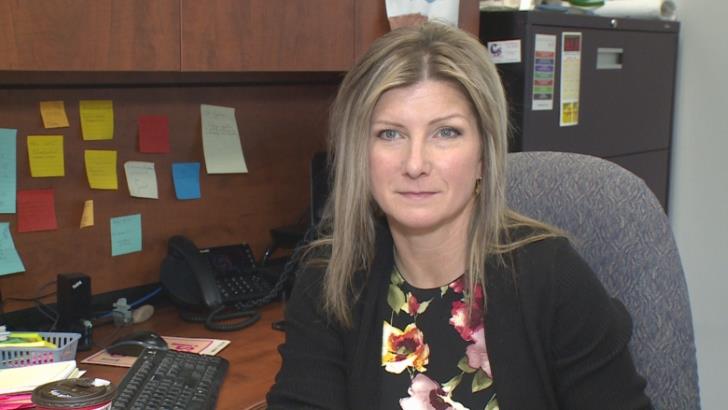
    Tina Gatt, manager of community outreach for the Windsor-Essex CAS office, would neither confirm that call nor address whether the incident merits an investigation.

    Gatt did say having kids walk to school to show them the “logical consequence” of misbehaving on the bus can be a reasonable punishment — as long as there are no safety threats, and there appear to have been no threats in this case.

    The mother accompanied the boys on the walk and, in the photos, are seen alongside what looks like a quiet, rural road. Harrow is a community of less than 3,000 people, about 30 kilometres southeast of Windsor.

    But “shaming” them on social media is not constructive, Gatt said.

    “I don’t want to judge or pretend to know all of the nuances of this situation with this parent, but [it’s] something to consider when we think about putting signs on kids that says what the bad behaviour is and putting them in a position where you take their picture and put it on social media,” she explained.

    “We would be concerned, and not just Children’s Aid, we should be concerned as adults, about shaming children.”

    a person with collar shirt: Tina Gatt, manager of community outreach for the Windsor-Essex Children’s Aid Society, says shaming simply doesn't help kids behave.


    Gatt said shaming rarely works with adults and “simply is not going to motivate children to be better.”

    She added it’s possible the mother was looking for reinforcement from her fellow parents that the punishment was just.

    “For this parent, perhaps it was to get some acknowledgement from her peer group to say ‘Is this right?’” Gatt said. “But just to be shaming children is not motivating for good behaviour.”